Implementing the feedback loop framework helps governments move from reactive one-off responses toward fostering a culture of government responsiveness to public voices about specific local problems. Responsiveness involves governments not just committing to change (with the commitment being an example of a response), but actually meeting its commitment and recognizing the legitimacy and relevance of the public’s input into the process; responsiveness can be enhanced when governments take the additional step to justify and explain their actions.31
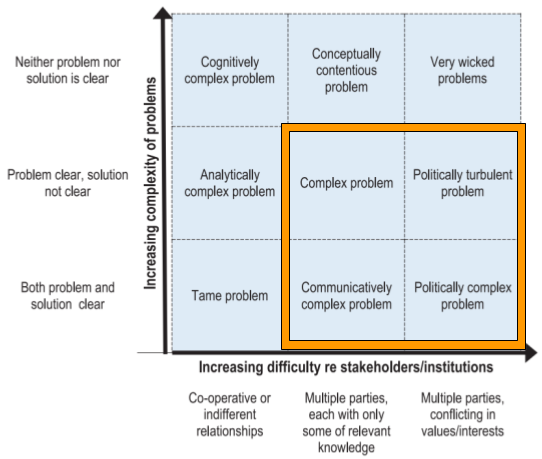
A problem or challenge is the discrepancy between how things are and how they should be or ought to be. The solution to a problem bridges that discrepancy, bringing us closer to an improved or ideal situation.
Depending on your context, your peers in the local authority may be more receptive to different framings of the question, “What are we trying to achieve with public input?” For example:
- “What choice should we make?” These are instances where participation helps improve decision-making, such as legitimizing decisions or co-creating policies. It is most useful when there is a clear set of options – e.g., Add a bike lane to street A or street B.
- “What is our top priority?” These are processes where public input to set priorities will help to navigate trade-offs, such as when residents are asked to decide which issue or challenge to address first. This question helps support drafting institutional documents like a budget, development plan or investment plan.
- “How can we improve?” You can consider a single program and aim for in-depth feedback (such as from immediate beneficiaries) to improve it, or leverage a broader concerns survey (see Step 4 and Annex IX on surveys) to identify the least or most popular services or public goods in the local authority (and then follow up to learn more about why residents feel this way).