
@media print { .callout-box { border: 1px solid #000; /* Black border for visibility in print */ padding: 15px; /* Padding to create space inside the box */ background-color: #f9f9f9; /* Light background color for contrast */ margin: 20px 0; /* Margin to space out the box from other content */ box-shadow: none; /* Remove any box-shadow */ } } Print Friendly and PDF

Implementing the feedback loop framework helps governments move from reactive one-off responses toward fostering a culture of government responsiveness to public voices about specific local problems. Responsiveness involves governments not just committing to change (with the commitment being an example of a response), but actually meeting its commitment and recognizing the legitimacy and relevance of the public’s input into the process; responsiveness can be enhanced when governments take the additional step to justify and explain their actions.31

A problem or challenge is the discrepancy between how things are and how they should be or ought to be. The solution to a problem bridges that discrepancy, bringing us closer to an improved or ideal situation.

Depending on your context, your peers in the local authority may be more receptive to different framings of the question, “What are we trying to achieve with public input?” For example:

  • “What choice should we make?” These are instances where participation helps improve decision-making, such as legitimizing decisions or co-creating policies. It is most useful when there is a clear set of options – e.g., Add a bike lane to street A or street B.
  • “What is our top priority?” These are processes where public input to set priorities will help to navigate trade-offs, such as when residents are asked to decide which issue or challenge to address first. This question helps support drafting institutional documents like a budget, development plan or investment plan.
  • “How can we improve?” You can consider a single program and aim for in-depth feedback (such as from immediate beneficiaries) to improve it, or leverage a broader concerns survey (see Step 4 and Annex IX on surveys) to identify the least or most popular services or public goods in the local authority (and then follow up to learn more about why residents feel this way).
SIGNPOST QUESTION

What problem are you trying to solve, and how will the feedback loop help to address it?

While the goal of “engaging more citizens in decision-making” is a useful starting point, the feedback loop process often benefits from a more concrete understanding of how feedback will be used. Setting priorities based on public feedback will help local authorities take these considerations into account when developing budgets, drafting development or investment plans, and devising long-term strategies. Recurring government planning processes offer important entry points for residents to share their views on the community’s direction. These are big-picture moments where public feedback can be used to navigate trade-offs (for instance, choosing to fund renovations to the school rather than build a new community center).

Box 7. Managing wicked problems through Listen, Respond, Report

Some of the problems local authorities handle are often called “wicked problems.”32 A wicked problem in public policy – such as crime, unemployment or high housing costs – poses unique challenges:

  • The problem is complex: Its constituent elements are hard to track or disentangle, are influenced by external factors and trends, and may shift or change over time.
  • The effect of any solution is uncertain: You cannot predict all of the consequences or risks of proposed solutions, and it is difficult to tell when the problem is truly solved.
  • Divergence between stakeholders: Opinions on the problem and the ideal solutions differ, reflecting stakeholders’ unique values, intentions and contexts.

These kinds of problems are never permanently solved, and instead the public official’s task is to manage them. Moreover, they often require coordination with levels of government, institutions, civil society and others outside the local authority. Even if these problems are uniquely challenging, they are still suitable starting points for feedback loop processes.

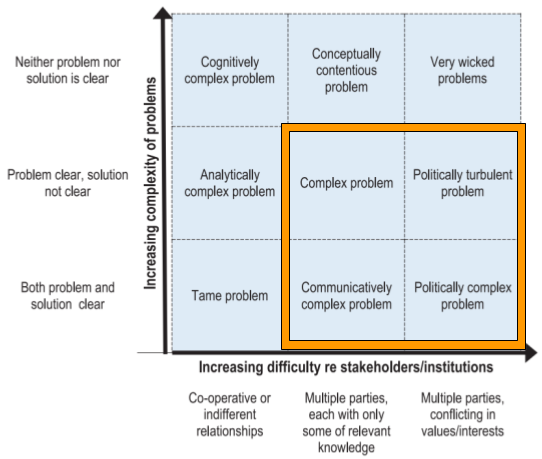
The chart in Figure 1 can help your team analyze the kinds of issues that could be addressed by a feedback loop – whether a wicked problem or something more routine. The bottom right section of the figure has been highlighted to indicate the types of problems where this feedback loop approach is most optimally useful. Problems that a feedback loop can ideally address should be clearly definable, as members of the public will need to readily understand the core issues at play. If the issues are highly complex or technical, you should turn to technical experts before the public.

Consider the two axes in Figure 1:

  • Increasing difficulty regarding stakeholders and institutions: Disagreement and opposition are part of local politics. The feedback loop process helps local authorities rank priorities and, in turn, speak to the public about the order in which identified priorities can be addressed and what is being done to resolve them. This communication helps those whose priorities are ranked lower than their neighbors still feel heard (“We will get to priority B, just not this year”) and learn the reasons why their priority ranks lower than others (e.g., “More people voted for project A”). A feedback loop will not resolve these divisions but can help the local authority navigate and manage them equitably and responsively.
  • Solutions are complex or not immediately clear: Once a problem has been identified as a priority, the solution may be obvious, but usually there are multiple ways to approach it. This is where efforts in Step 7 (on dialogue and co-designing solutions) will be helpful. Ultimately, it will be the government’s decision to determine and act on the best or most feasible course of action, but public input can be useful in exploring and weighing alternatives and trade-offs. In addition, communications around the process – including explanations for why and how a certain course was chosen – can help bring the public along with whatever course of action is decided.

Figure 1: An evaluation matrix of tame and wicked problems in public policy. The highlighted portion indicates problems most suitable for the Listen, Respond, Report approach. Reproduced with authors’ permission from John Alford & Brian W. Head (2017) “Wicked and Less Wicked Problems: A Typology and a Contingency Framework.” Policy and Society. 36:3, page 402

The image is a 3x3 matrix categorizing problems by their complexity and stakeholder difficulty. The vertical axis ranges from "Both problem and solution clear" at the bottom to "Neither problem nor solution is clear" at the top, indicating increasing complexity of problems. The horizontal axis ranges from "Co-operative or indifferent relationships" on the left to "Multiple parties, conflicting in values/interests" on the right, indicating increasing stakeholder or institutional difficulty. Each cell represents a type of problem, including "Tame problem," "Analytically complex problem," "Cognitively complex problem," "Communicatively complex problem," "Complex problem," "Conceptually contentious problem," "Politically complex problem," "Politically turbulent problem," and "Very wicked problems." Four cells in the middle and right columns of the bottom and middle rows—"Communicatively complex problem," "Politically complex problem," "Complex problem," and "Politically turbulent problem"—are highlighted with an orange border.

Context questions for authorizing the feedback loop

When selecting the problem your feedback loop approach will address, you will need to consider how that problem (and especially the implementation of any particular solution) fits into the decision-making and governing processes of your local authority. The following questions will help generate a quick stakeholder mapping (see Section 1.6 and Box 10 for a more detailed stakeholder mapping exercise) and context analysis that can support an initial decision to authorize the process.

If necessary, a more robust context analysis can be conducted once a team is formed (Step 2); see questions in Annex III: Context Analysis and Do No Harm.

Is the problem within the jurisdiction of the local authority? Who will be responsible for implementation?

If the local authority cannot control its own budget or make decisions concerning the problem, then in the near future there will be no effective outlet or corresponding action based on public feedback. The local authority should start by asking for public participation in making decisions that it is responsible for; otherwise, the local authority risks undermining public trust by setting unachievable expectations. If the decision is outside the local authority’s control (and rests with a national ministry, for example), the best the local authority can do is use public input to advocate on behalf of the community; this should be seen as a long-term effort. The local authority should also inform residents that local leaders cannot immediately fix a problem (and explain why), even if they agree that it should be fixed and have urged higher-level authorities to take action. In addition, consider which staff, agencies, or departments of the local authority are responsible for deciding or coordinating implementation: Does the mayor decide alone, or do they need the council’s approval? What departments may need to work together and be consulted on the feasibility of proposed solutions?

However, it is possible that residents and the local authority will agree to take on a challenge that is beyond the local authority’s responsibility or capacity to address alone. This will often present a wicked problem, especially because more stakeholders will have an interest in the process as issues cut across multiple communities and jurisdictions. For example, a small town near mines or a major port may not have the jurisdiction to regulate oversized vehicles using nearby highways but will struggle with the effects of this traffic on road quality and safety. In this instance, the feedback loop may only be “closed” or reach a resolution after action or regulatory activity by a national ministry. The local authority may have some success advocating on behalf of the community, but their advocacy will be harder to ignore when acting jointly with peers in neighboring communities. See the following example:

Box 8. Learn from experience – Advocacy group of mayors from the Prut Valley, Moldova

In the last decade, mayors, local councilors and residents living along Moldova’s national route R34, which connects main country roads with the commercial port of Giurgiulești, experienced an increase in heavy trucks traveling to and from the port. This increased traffic and tonnage damages the roads, and occasional reckless driving poses dangers to traffic and people living nearby.

In 2015, mayors from 13 villages – unable to address the problem alone – formed a collective advocacy group with the aim of making the route safer and better managed. This group engages various local and national government agencies, including the Ministry of Transportation and the Ministry of Internal Affairs. In 2017, the advocacy group and these agencies developed a joint action plan to address the issue, including a system to monitor traffic in real time, working with police and other local administrations to install and manage the equipment. Over the years, the group has grown to include additional local administrations. The mayors continue meeting to share advice with representatives, introduce their efforts to newly elected mayors from communities along the route, and advocate to the national government to fund needed improvements. Throughout the process, they have supplemented their advocacy with surveys of their residents and provided updates on their joint progress to their local constituencies.

Does the local authority reasonably expect to have the capacity (resources, staff, etc.) to solve this problem and to implement the feedback loop?

While a local authority is legally allowed to make a decision, it still needs to follow through and take action. This question will be dealt with in greater detail by the core team in Step 3, but an initial evaluation of the local authority should indicate whether it has or lacks capacity to take action. Many local authorities focus on processes that must happen (regardless of whether the public is involved in the decision or not), such as planning, budgeting and service delivery. There is an existing process, staff and general administrative capacity in place to (more or less effectively) complete these tasks; the question then becomes how the local authority can bring public feedback into the process.

Can we engage the public effectively? Can we make the question easy to understand, ensure broad participation and use the feedback we receive?

Section 1.3 of this step focuses on the local authority’s current public engagement. In addition to understanding the strengths and weaknesses of current public communication and dialogue practices, the local authority should be ready to present the process and requests for public feedback in a way that is easy to understand. To participate effectively, residents will need to understand enough about the process, the information and feedback they are being asked to provide, and how it will be used.

Examples of feedback loops in action

Consider the following applications of feedback loops by local authorities from around the world:

Setting budget priorities

  • In Moldova, mayors implemented feedback loops to set budget priorities, using residents’ surveys to rank which development projects – often related to infrastructure or services such as garbage collection – to address first. Priority-based budgeting is an increasingly common approach to setting priorities strategically and using public input to navigate trade-offs in budget allocation.
  • In Slovakia, teams of mayors and local councilors analyzed the results of a door-to-door survey to rank top priorities for investment, with residents selecting between issues such as roads, parking and recreation.
  • Cities in the United States, such as St. Paul, Minnesota; Lawrence, Kansas; and Fort Worth, Texas, have deployed a priority-based budgeting approach that allows residents to individually explore budget scenarios and trade-offs. By placing residents in the role of decision-maker, the budget simulation (called the Balancing Act) helps residents understand the constraints, context and consequences of the local budget process and informs their feedback to local leaders.33

Developing strategies and plans

  • In Mexico, city planning departments used public feedback to co-create municipal development plans or government programs, which are strategic documents that define and direct the work of municipal government to promote local development and improve the quality of people’s lives over three years.
  • In El Salvador, civil society and officials worked together to collect feedback from local artisans and entrepreneurs, using the information to generate recommendations on improving the local economy.

Improving or expanding particular services

  • A feedback loop can be used to assess residents’ perceptions of a particular municipal program and to source ideas for improving it. In Georgia, local officials and civil society examined the performance of a municipal economic grants program, holding discussions with beneficiaries (and unsuccessful applicants) to source feedback on how the application, approval and management process of the grants could be improved.
Footnotes

31 Jonathan Fox et al., Disentangling Government Responses: How Do We Know When Accountability Work Is Gaining Traction? (Accountability Research Center, 2024), Link. See page 8 and the figure on page 14 in the article for more on the differences between one-off responses, responsiveness, and the concept of “accountable responsiveness.”

32 John Alford and Brian W. Head, Wicked and less wicked problems: A typology and a contingency framework (Policy and Society, vol. 36, no. 3, 2017), 397-413, Link. The term wicked problems emerged in the 1970s to describe how problems in public policy and governance are different from so-called “tame” problems of engineering and mathematics. A difficult math or engineering problem can eventually be solved.

33 Several US cities have reportedly engaged with Polco's Balancing Act platform for citizen engagement (presentations by local officials during public webinars, 2024). For more information on Balancing Act, see: Jessie O’Brien, Balancing Act (Polco, n.d.), Link.