
The following ten-step process was developed through the course of NDI’s support to local authorities in Moldova, which began in 2010. Funded by United States Agency for International Development (USAID), the program increases accountability and trust with constituents by demonstrably listening to and responding to concerns.
Between 2016 and 2022, local politicians in the program conducted more than 290,000 door-to-door discussions with constituents and over 400,000 online interactions. The resulting feedback was used to resolve more than 1,200 local issues. Mayors engaged under the program use online and in-person surveys to identify priorities, publish regular updates on priority issues and use feedback to advocate for their communities on a range of issues at the regional or national level. Most local officials who participated in the program secured improvements in their constituents’ lives through a combination of local and national government actions, community self-help and international donor aid. For instance, Moldovans received new water pipes, repaired roads and waste disposal systems.
In each Moldovan municipality, the process lasts between 10 and 14 months for a full cycle (from the decision to engage the public on priorities to the final update on progress). Note that in Moldova, municipalities are often quite small (fewer than 1,000 households), and the process is implemented by teams of at least four elected officials and staff. You can see a flowchart indicating the various steps of the process, developed by NDI, in Figure 3 below. An example timeline, based on the experiences of Moldovan municipal leaders and the steps in Figure 3, follows:
Figure 3. Ten steps of the NDI feedback loop process in Moldova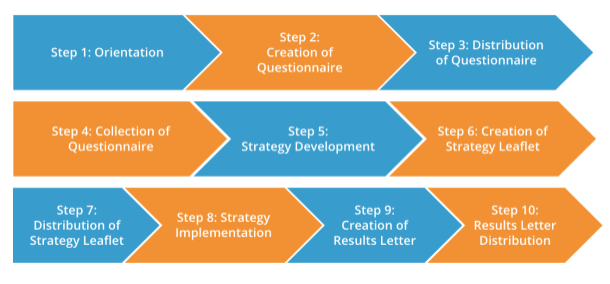 |
Month 1 | Step 1 – Kickoff meeting and identification of core team |
Month 2 | Step 3 – Distribution of the questionnaire on local priorities through a door-to-door canvassing method, reaching at least 10% of households in the community |
1 week later | Step 4 – Questionnaire collection (going door to door again) |
Months 3 to 4 | Step 5 – Analysis of survey results and development of the results report and local strategy |
Month 6, 7 or 8 | Step 7 – Verification of the progress of the strategy (Two to four months after the strategy is implemented, the team should convene to discuss tangible results and progress made.) |
Month 8 | Step 9 – Distribution of the report on intermediate/final results |
Between months 10 and 14 | Step 10 – Development and distribution of final publications, outlining additional progress to date and future plans on priorities identified in the survey (and other issues as relevant) (This publication may coincide with an annual report or other large occasion.) |
After years of working with mayors, alums of the project established a Club of Local Champions (60 mayors who are champions of more responsive governance practices). These champions make constituent outreach a regular part of their work outside of and in addition to the 10-step cycle. Most notably, the initiative created a culture and expectation that mayors and councilors report (before voters ask and outside of election campaigns) how they have fulfilled their campaign promises and delivered on residents’ priorities. In addition, because it convened mayors from across the country, the club began national-level advocacy for common issues – specifically universal access to safe drinking water.
The rayon of Ștefan Vodă (rayons are administrative districts that typically include several towns and villages) offers another notable example of how local efforts can build on each other. Local mayors and councilors from the rayon had spent three years compiling resident priorities through door-to-door canvassing. Based on those responses, the rayon council developed and adopted a five-year plan for the rayon’s development. In another example, mayors along a major highway have sought to reduce heavy truck traffic, working together to advocate for and implement incremental changes with the national government (see Box 8).
Overall, the shift has developed a culture of “two-way communication” that local officials sometimes refer to as “year-round campaigning” – but this is the kind of continuous citizen outreach about important local issues and progress toward addressing them that is more common in established democracies. Citizens expect that they will be consulted on key issues and policies, that policies and plans will reflect community will to the greatest extent possible, and that they will receive information about governmental plans and actions. Officials also understand the political value of accountability – as evidenced by their higher-than-average election rates (even compared to other incumbents) mentioned in Box 2. As a result, local mayors and councilors are embracing citizen consultation practices in additional areas, such as through transparent budget development.